Narrative
History of the Hôtel Baudy
A house in Giverny that became, at the end of the 19th century, one of the meeting points of the artists’ colony.
- 1869The oldest papers in the collection: Baudy fils, haberdashery
- 1886Willard Metcalf pushes open the shop door
- 1887 — 1899Years covered by the surviving guest register
- 1894Paul Cézanne’s stay, attested by the house register
I
Origins
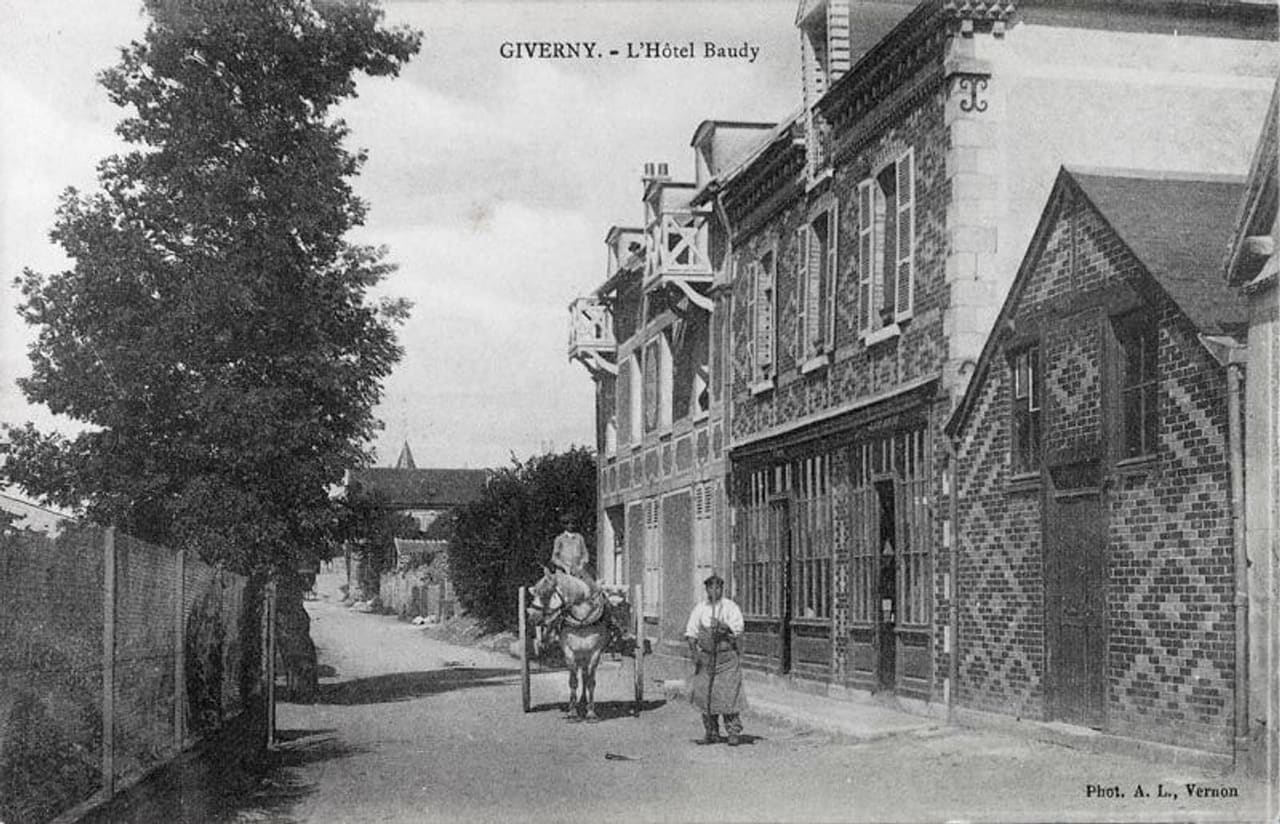
Before it was a hotel, the house was a village shop. The oldest papers in the collection, dated 1869, give its exact trading name: “Baudy fils, haberdashery and perfumery, sewing machines and their supplies”. It also sold soap, paper, ink, pen nibs, hosiery and footwear; Lucien, a sewing-machine salesman, had set up his repair workshop behind the shop.
Lucien Baudy was born in 1848, Angélina in 1853 — she was the daughter of Jean-Jacques Ledoyen. Lucien died in 1896 at the age of forty-nine; his wife, widowed at forty-three, carried on alone and gave the house the shape we know.
People bought tobacco there, drank a glass of cider, exchanged the news of the village. That first function explains the layout of the place: a common room at the centre, outbuildings behind, a garden climbing the hillside.
Nothing marked out this shop to become an international crossroads. What changed everything was an address — Giverny — and a neighbour who had settled a few hundred metres away four years earlier.
II
Giverny becomes a village of artists
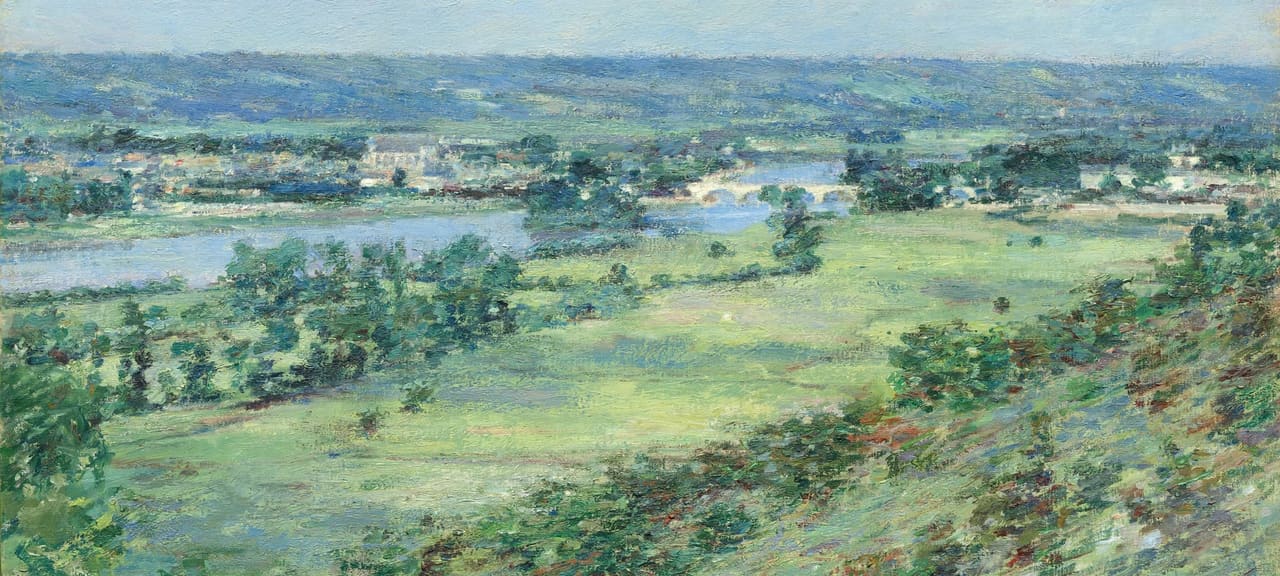
Claude Monet settled in Giverny in 1883 and lived there until his death in 1926. His presence determined everything that followed. Institutional sources nonetheless describe him as a reserved neighbour who did not encourage younger artists to follow him: this was not a master recruiting pupils, but a reputation drawing people in.
In 1886 an exhibition organised by Durand-Ruel in New York introduced Impressionism to the American public. That same year a young painter from Massachusetts, Willard Metcalf, twenty-six years old, pushed open the shop door: the Peers de Nieuwburgh collection gives him as the first, and tells how Angélina, faced with this unkempt visitor speaking broken French, nearly turned him away before she caught sight of his painting kit. Back at the Académie Julian in Paris, he described the village, the light, Monet’s presence, and prices within reach of young artists.
In 1887 John Leslie Breck arrived with a first group of expatriates. Angélina Baudy agreed to lodge them. The colony was born.
III
The American painters
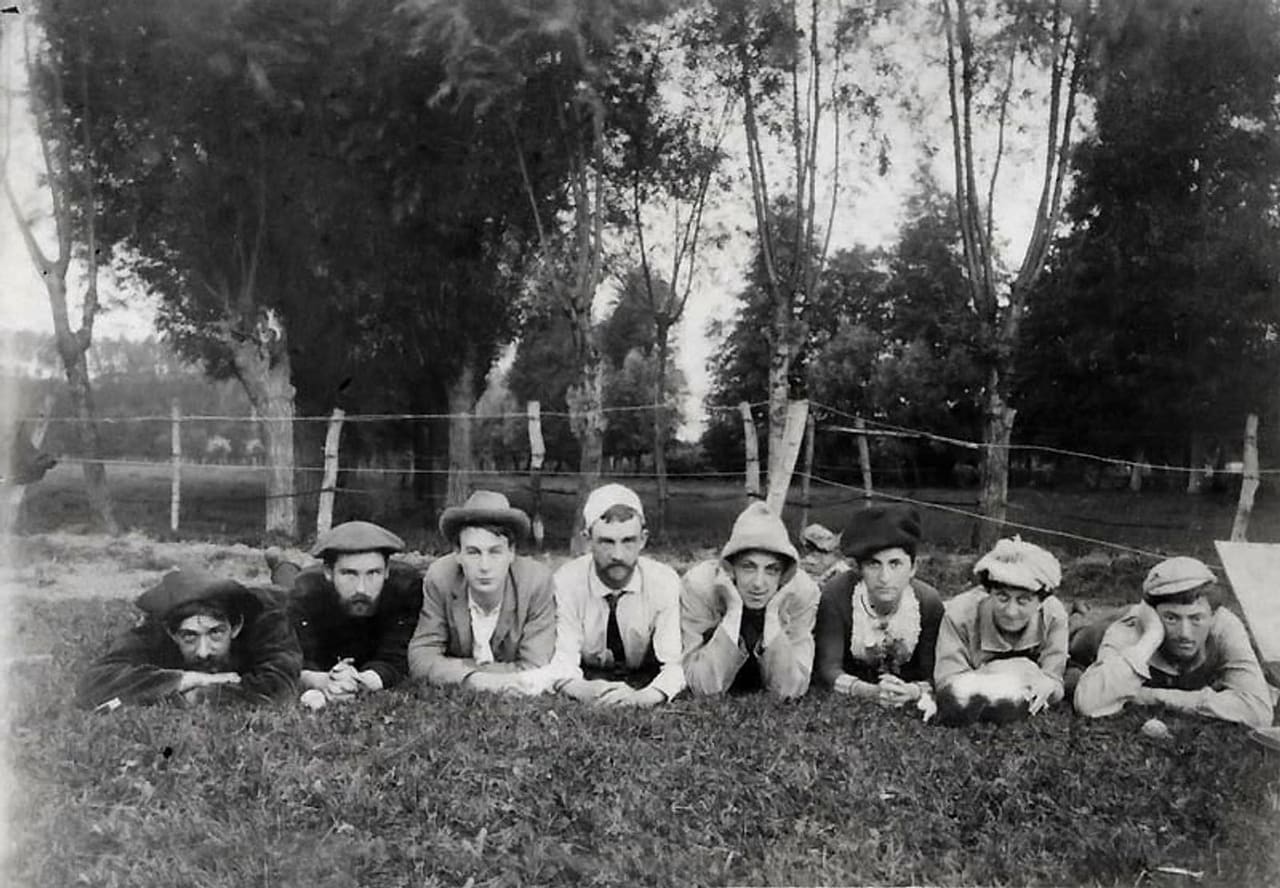
The colony of American painters who stayed in the village between 1887 and the First World War is known as the “Giverny Group”. It was not a school: it was a place, a period and a shared passion for working outdoors. The Hôtel Baudy became its headquarters.
Theodore Robinson was the closest to Monet — a real friendship, and one of the deepest assimilations of French Impressionism by an American. John Leslie Breck and Lilla Cabot Perry also kept up sustained relations with him; Perry returned for nine summers between 1889 and 1909 and made Monet’s work known in the United States. In 1887 Willard Metcalf painted “The Ten Cent Breakfast”, which shows the interior of the house.
From 1898 a second pole appeared: Frederick William MacMonnies and Mary Fairchild MacMonnies settled in the village’s former priory, bought in 1901, where MacMonnies opened a summer studio-school in 1905. The colony now had two centres, the hotel and Le Prieuré.
A second generation followed: Frederick Carl Frieseke spent the summers of 1906 to 1919 there, Richard Edward Miller those of 1906 to 1912. Around them, Theodore Earl Butler — who married Suzanne Hoschedé, Monet’s stepdaughter — Guy Rose, Lawton S. Parker, Louis Ritman, Karl Anderson, Edmund Greacen, Alson Skinner Clark, Karl Albert Buehr, Matilda Browne. On returning to the United States they became the ambassadors of American Impressionism.
Giverny was not an isolated interlude: a dozen of these painters — Willard Metcalf, Edmund Greacen, Lawton Parker, Lucien Abrams, Charles Ebert, Louis Paul Dessar, Martin Borgord, Ivan Olinsky, Allen B. Talcott, George Glenn Newell, Charles M. Young — would meet again in another colony, Old Lyme in Connecticut, around Florence Griswold’s house. The way of living there was the same, down to the habit of leaving one’s canvases on the walls of the house that lodged you.
IV
Life at Baudy
The studio was built in the garden in 1887: a free-standing pavilion lit by a north-facing skylight, where painters working out of doors came to finish their canvases. The Peers de Nieuwburgh collection credits the initiative to Theodore Robinson. Two further studios were fitted in 1890 under the roof of the house, likewise beneath north-facing skylights. The enlargement, carried out between 1888 and 1891, made the whole the first establishment in France designed for painters.
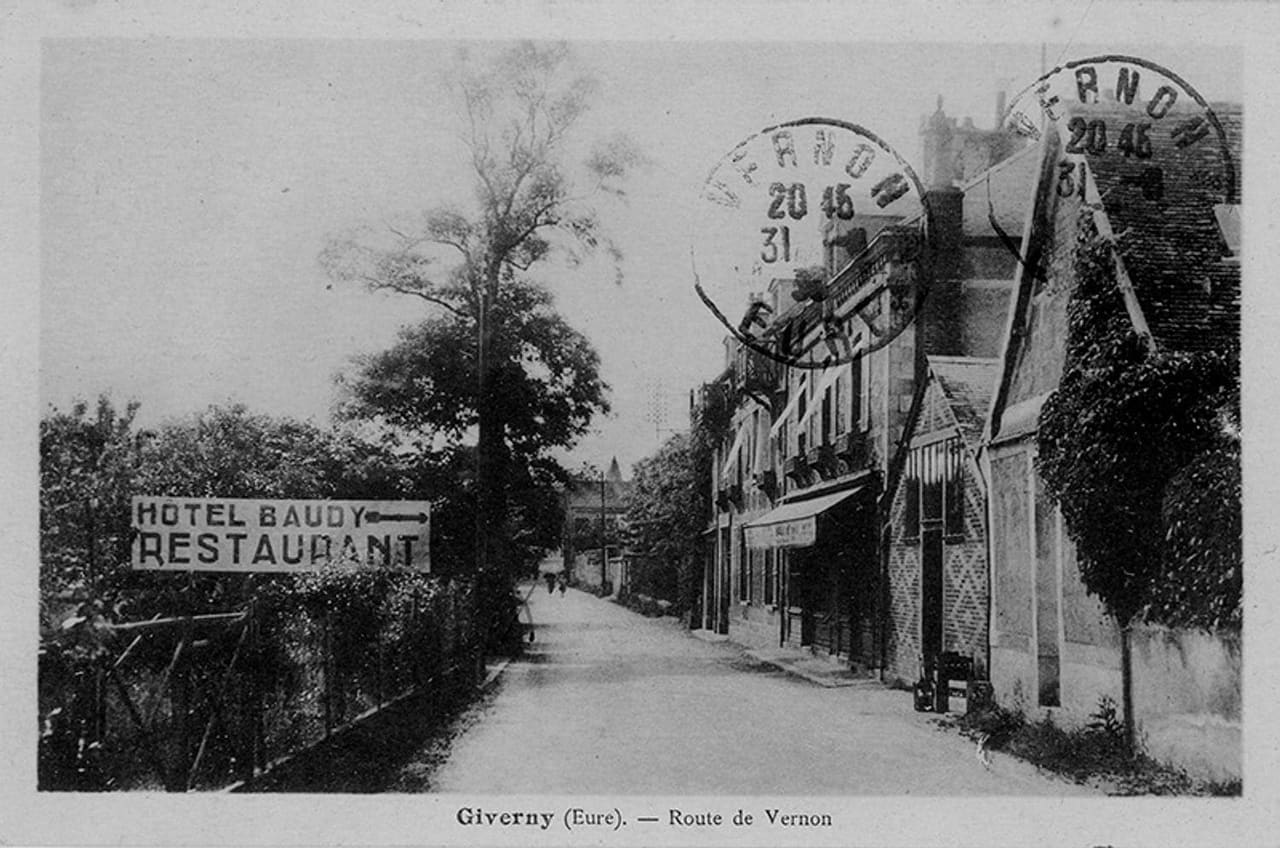
Angélina Baudy turned the shop into a house able to receive an international clientele: some twenty bedrooms, a dining room, and a large corner terrace facing south-west — it was from there that Cézanne painted his “Giverny (hôtel Baudy)” in 1894. Lucien’s sewing-machine workshop became a ballroom.
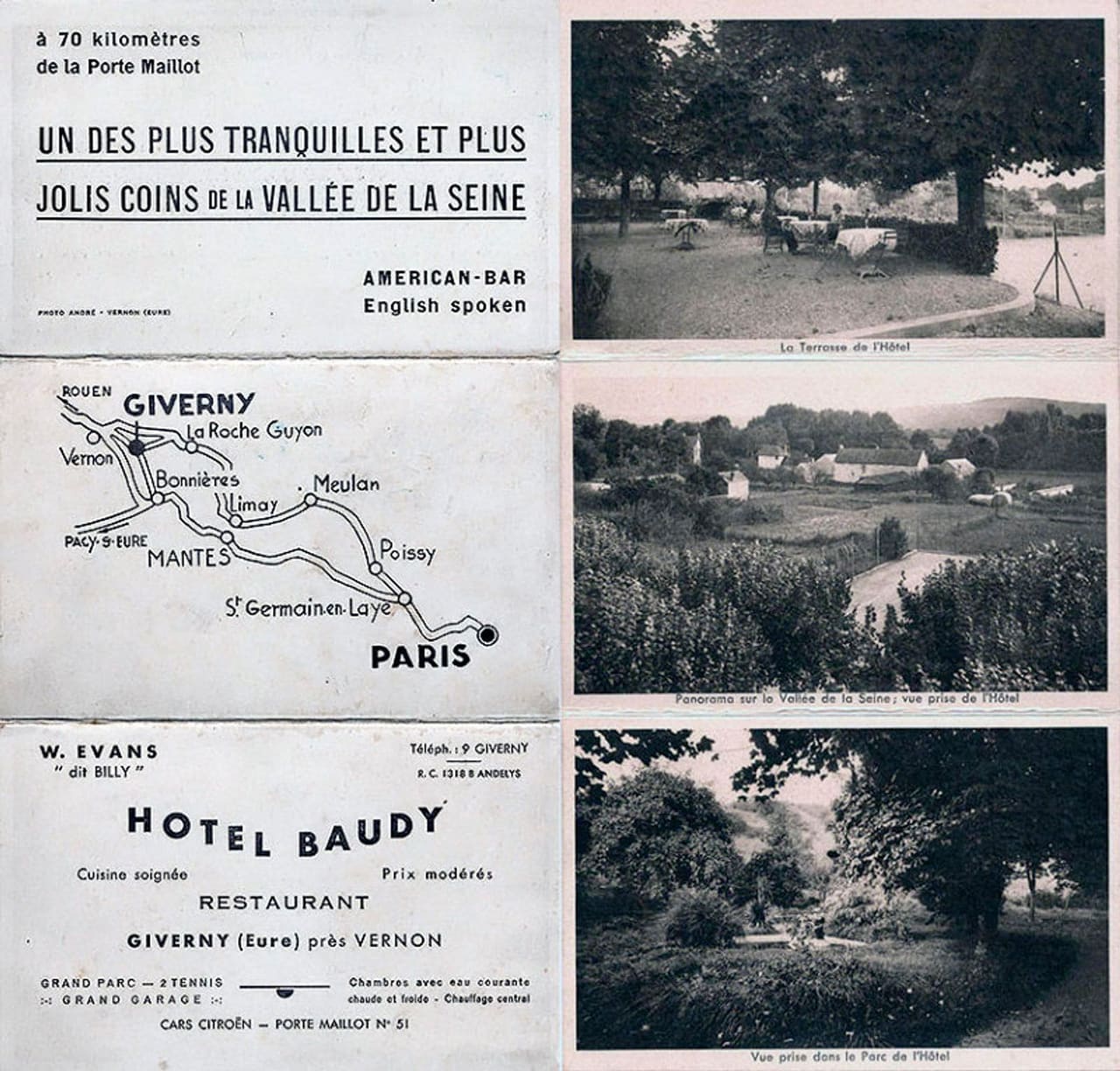
The gate and the counter remained those of a village grocery — which now also sold easels, stretchers and brushes supplied by the Paris houses Lefebvre and Foinet. But English was spoken, an “American-Bar” was served, and the house advertised its two tennis courts. Board cost five francs a day.
The kitchen adapted to its guests: Angélina learned to make tea, served Christmas puddings and American dishes down to Boston baked beans, and her recipe book has stayed in the house. Between sessions there were masquerade balls and games of billiards, and canvases went up on the dining-room wall. A letter written from the hotel on 4 August 1903 by the painter Sears Gallagher confirms it in passing: “all the artists have left sketches in the hotel”.
Life in the house was not only painting. Tennis tournaments were held — Stanton Young passed for the player to fear — and there was skating, shooting, and rowing down the Seine to Bennecourt. The young people of Giverny gave musical and theatrical evenings of which four programmes survive: 27 February 1898 and 4 February 1900 in aid of the school library, 27 February 1910 and 30 April 1911 in aid of the Société de Tir. Dawson Dawson-Watson and Theodore Earl Butler produced a paper there, “Le Courrier Innocent”; a Franco-American menu in Butler’s own hand is kept in the collection.
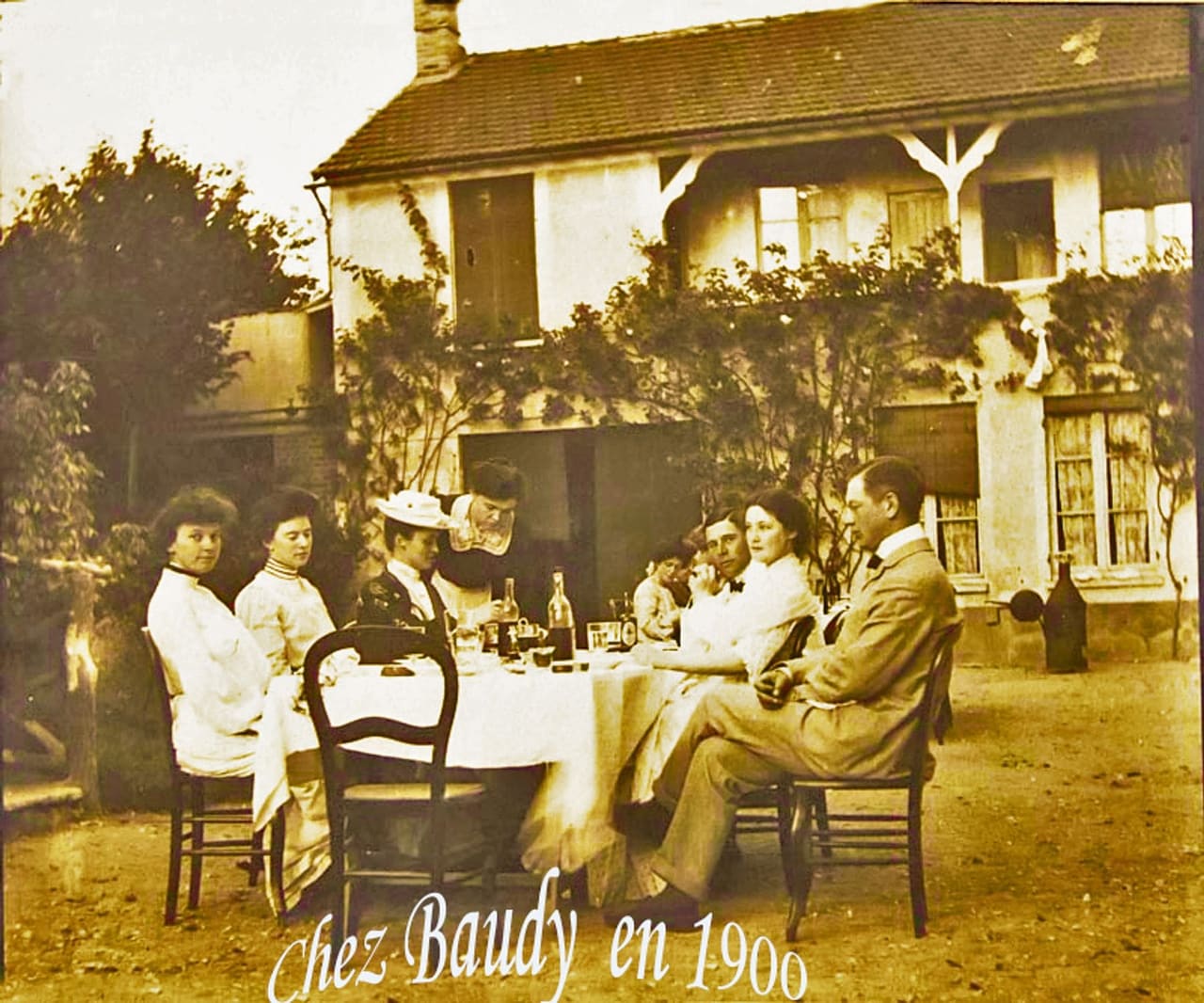
Board and lodging stayed cheap. Guests shared simple meals, argued about painting, played tennis on the garden courts. A penniless lodger might settle his bill by leaving his canvas behind: that is how the house built its collection, and how sketches of works that later became famous stayed hanging in the dining room.
“70 kilometres from the Porte Maillot — one of the quietest and prettiest corners of the Seine valley. American-Bar. English spoken.”

V
The gardens
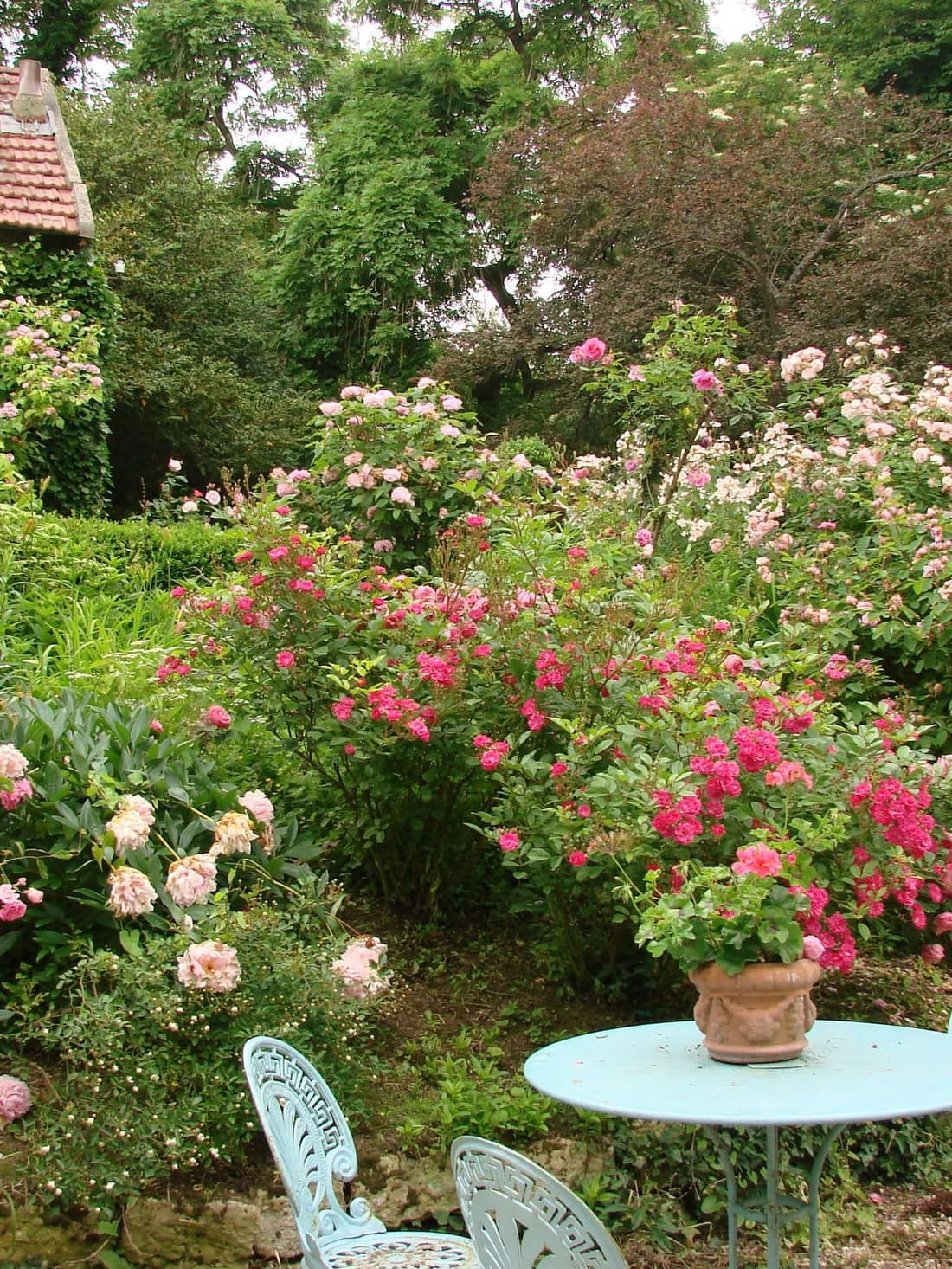
The garden climbs the hillside behind the house: today a park of one hectare with many flower beds. It was there that the lodgers set up their easels, a few steps from their rooms — the photographs in the collection show them at work beneath the fruit trees, and laying the table in the open air.
Painting in the garden was not decoration but method: open air, changing light, the immediate closeness of the motif. The terraced rose garden that now climbs the slope was laid out between 1989 and 1991 by Christian Jeanney. The garden is now the subject of a separate project led by the association Les Jardins Baudy des Peintres Américains.
VI
The artists’ studio
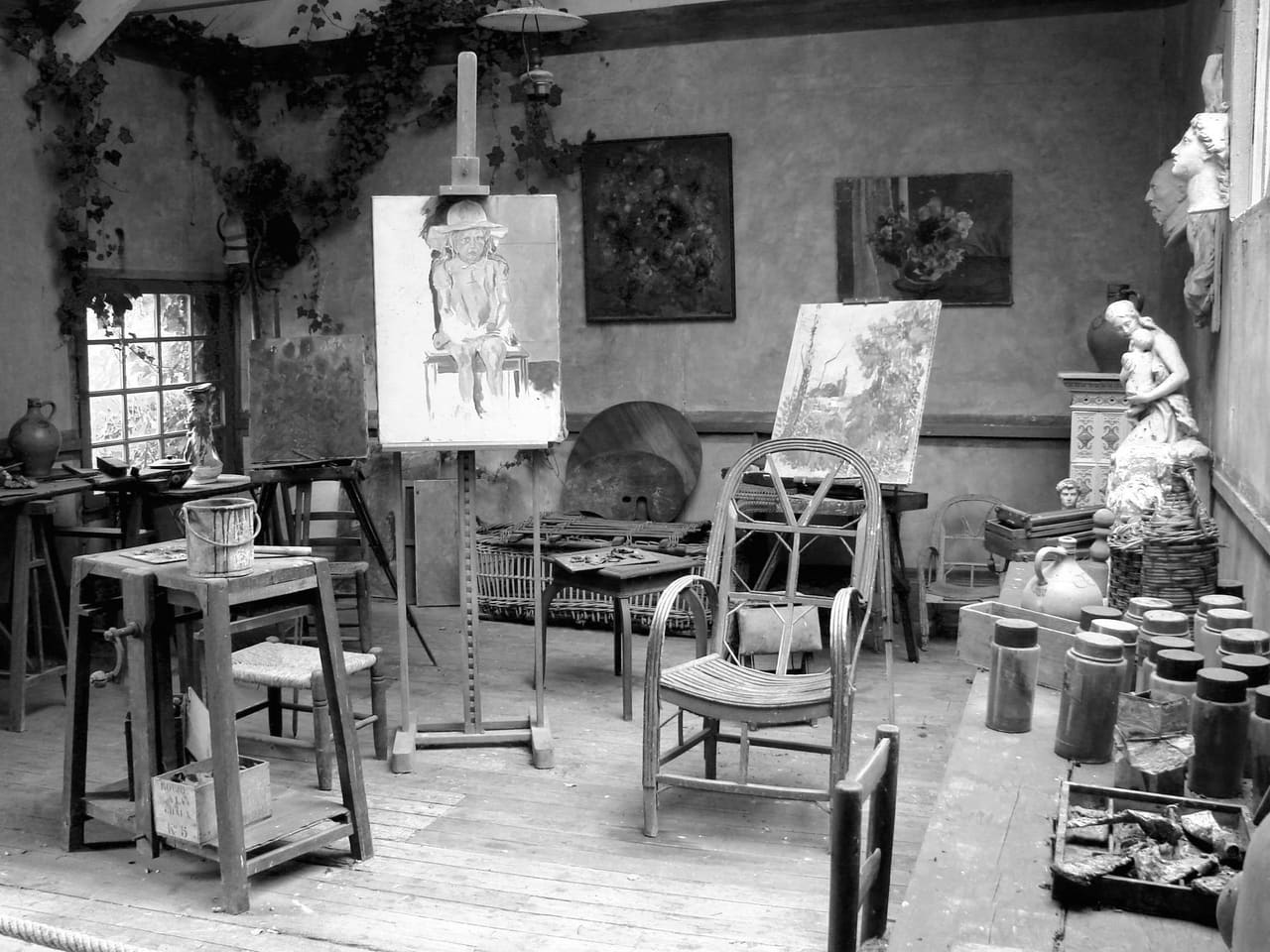
The house had as many as three studios. The first was built in the garden in 1887, away from the house, at the painters’ own instigation — the Peers de Nieuwburgh collection credits the idea to Theodore Robinson; two more were fitted under the roof in 1890. All lay beneath north-facing skylights: the orientation is not incidental, for northern light does not turn and barely varies through the day. That is the condition painters look for.
Only the garden studio survives today. It is preserved and freely open to visitors: easels, canvases propped against the walls, plaster casts and studio furniture.
VII
The 20th century
The First World War scattered the colony. Exchanges continued for a time, and then the house changed function. Angélina Baudy held on: helped by her daughter-in-law Clarisse, widow of her son Gaston, she was still serving in the hotel into the 1930s. Her granddaughter Suzanne grew up in the park.
An advertising leaflet kept in the collection shows the establishment under different management: the heading reads “W. EVANS ‘dit BILLY’”, with “Téléph. : 9 Giverny” and “R. C. 1318 B Andelys”. That number refers to the French commercial register in use from 1920 until 1 March 1954 — the letter B denotes a company. It carries “American-Bar”, “English spoken”, a large park, the tennis court, a large garage and a Citroën coach service from the Porte Maillot. The painters’ hotel had become a motoring resort.
The next war ended it brutally. J. Walley Evans, known as Billy, was arrested at the start of the conflict; he died at sixty-two of the effects of torture at the Kommandantur, and lies in the cemetery at Giverny. In the winter of 1941 his wife lent the former studios for the village catechism classes. Angélina Baudy died in October 1942, aged eighty-nine.
Successive owners, damage, alterations: this is the least documented period in the history of the house.
VIII
Baudy today
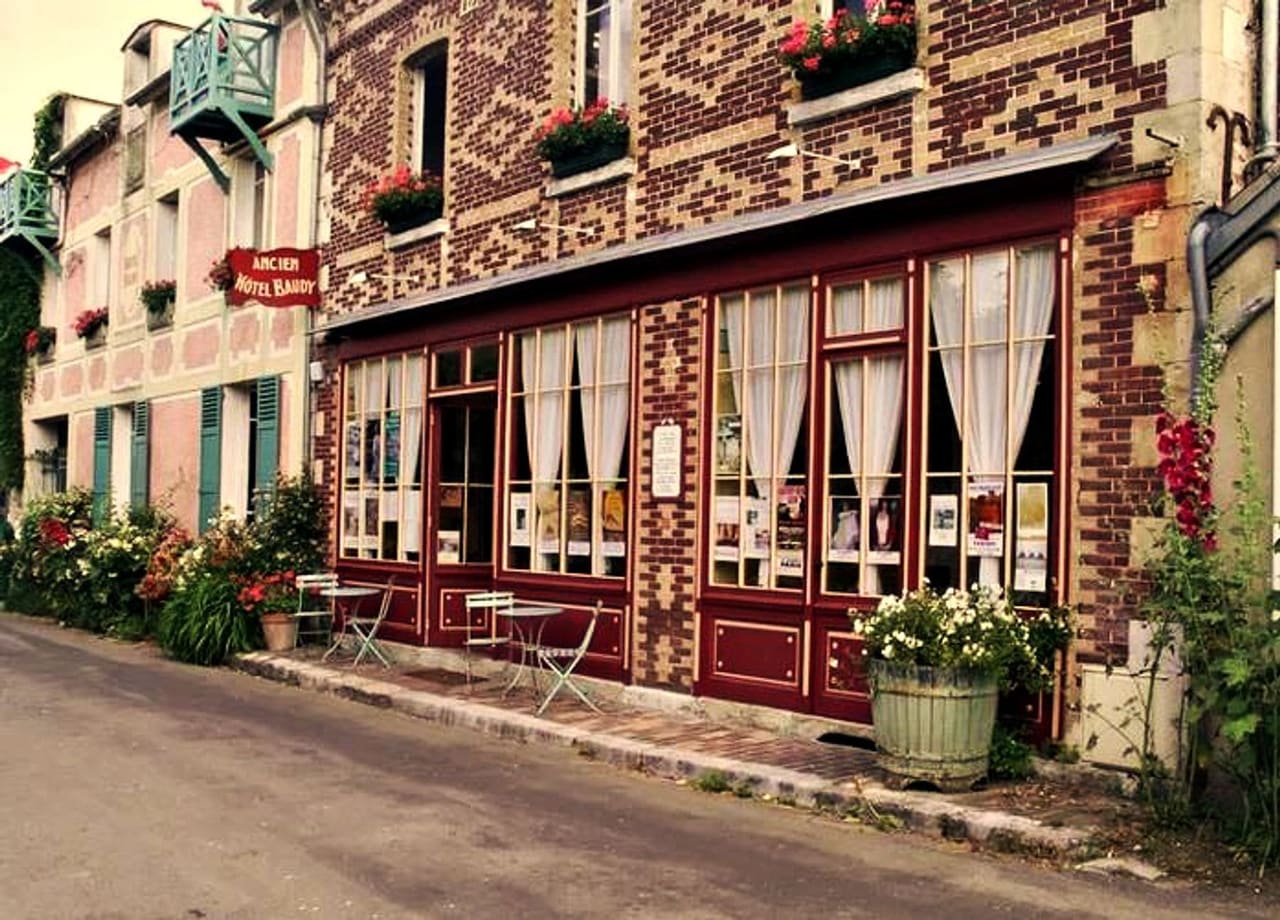
The house is now home to Restaurant Baudy, at 81 rue Claude Monet. The studio is freely accessible and the park open to walk through.
Alongside the restaurant, the association Les Jardins Baudy des Peintres Américains is working to make the garden a place of memory for the artists’ colony.
IX
What the archives say
A historic house is told through documents, not recollections. The decisive record for the Hôtel Baudy is its guest register, kept from 1887 to 1899: some seven hundred entries, giving for each lodger their occupation, age, residence, passport origin, previous address, destination and arrival and departure dates. It is the source that can say with certainty who slept here, and when.
That register is no longer in Giverny. The original is held at the Philadelphia Museum of Art; the Smithsonian Institution’s Archives of American Art hold a microfilm reproduction made in 1989 — reel 4236 — which is the only form in which it can be consulted. According to their provenance note, the guest book was given to the museum by Alice Osborn, who had bought a Cézanne painting from Madame Baudy and received the register as proof of the painter’s stay. Any publication or reproduction requires written permission from the Philadelphia Museum of Art.
The register is not alone. The Philadelphia Museum of Art holds, under the name “Hotel Baudy Collection”, a group of papers running from 1887 to 1922 — half a linear foot, mostly in French — which came to the museum with Frank Osborn’s 1920 acquisition of Cézanne paintings, and which documents the painter’s stay at Giverny and the provenance of his canvases. It is open for research and has not been worked through for this site.
The two holdings hang on the same thread. Cézanne, leaving Giverny in 1894 without taking all his canvases, left some at the inn; one of them was later sold by Madame Baudy, and it was as a warrant of its provenance that the guest register passed to the buyer, and then to the museum. The archive of the house followed the road of its paintings.
Until those documents have been worked through, part of what is told about the house belongs to oral tradition rather than to the archive.
A second, closer source has been drawn upon: the Giverny collection of JM Peers de Nieuwburgh, which brings together postcards, photographs and printed matter from the village and documents the history of the house in detail. The facts used here are used with his permission.
The collection kept on the premises — photographs, postcards, printed matter, paintings — is being inventoried.
Sources